When Love Becomes Curriculum

What a children’s book taught me about teaching Black children
By David E. Kirkland, PhD
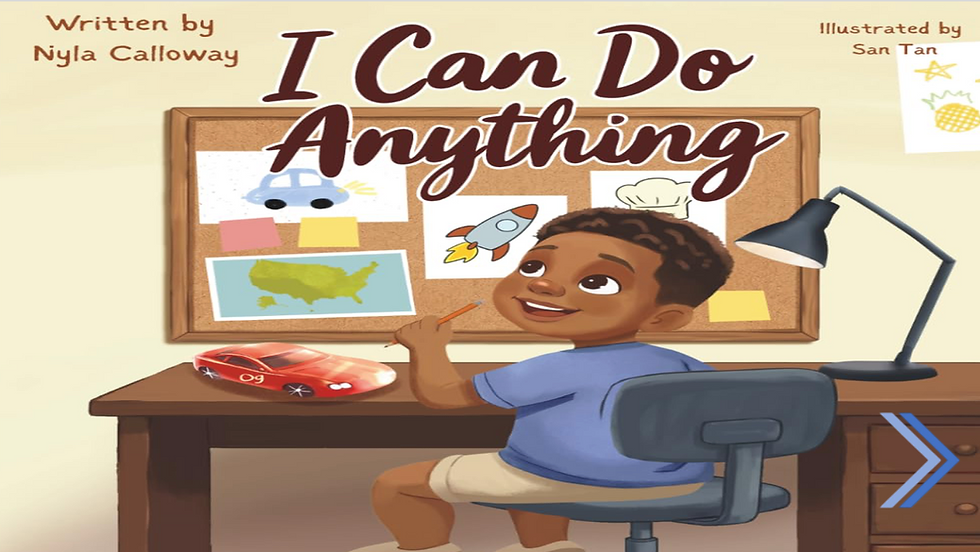
This summer, I came across a remarkable children’s book by Nyla Calloway, a young Detroit-area teacher and author. Her picture book, I Can Do Anything (Milestonstones Ink, 2026), is deceptively simple. Like many of the best books for children, it seems to tell a small story while quietly carrying a much larger theory of learning beneath each page.
The story follows a young boy named Amari, who, whenever he becomes frustrated after failing at a task, declares, “I can’t do it.” His mother gently interrupts that narrative with another: “You can do anything.” At first, her words seem like encouragement. But as the story unfolds, they reveal themselves as something so much deeper—a pedagogy.
Again and again, Amari borrows his mother’s belief until, eventually, it becomes his own.
The book’s most beautiful moment comes near the end. Alone on a basketball court, Amari misses shot after shot. Under his breath, he whispers the familiar refrain: “I can’t do it.” Then another voice interrupts—not from outside him but from within. He hears his mother’s words echo in his mind: “You can do anything, Amari.” He steadies himself, shoots again, makes the basket, and shouts triumphantly, “I can do anything!” That voice does not appear by accident. Someone teaches it. Someone loves it into existence.
But Calloway reserves perhaps her most profound lesson for the final pages. Returning home, Amari finds his mother struggling with a task. Discouraged, she says, “I can’t do it.” Without hesitation, Amari offers back the very words that have been shaping him: “You can do anything.” She tries again, succeeds, and together they declare, “I can do anything.”
It is a stunning reversal. The teacher has become the student, and the student has become the teacher. Learning has come full circle.
For many readers, this may simply be a story about confidence or perseverance. It certainly is. But the book also illustrates one of the oldest and most enduring pedagogical traditions in Black life—the recurrent labor by which Black mothers teach Black children to survive, flourish, and imagine themselves beyond the limits the world imposes on them.
This is not the language of toxic positivity, nor is it the contemporary obsession with grit. In fact, reducing Calloway’s story to perseverance alone misses its deepest insight. Grit is often masked as an individual trait—the personal capacity to endure hardship. I Can Do Anything, by contrast, reminds us that resilience is first relational, not personal. Children rarely begin by believing in themselves. They first learn to believe because someone else believes in them.
For generations, Black families have understood that children inherit more than genetics. They inherit stories. They inherit expectations. They inherit ways of seeing themselves long before they have the language to describe who they are. Against a society that has too often narrated Black children through a deficit vocabulary—telling them, explicitly and implicitly, what they are not, what they cannot become, and what they supposedly lack—Black mothers have long practiced a different kind of instruction. They answer the world’s diminishment with deliberate affirmation. They teach dignity before the world can deny it. That’s pedagogy. Indeed, it may be one of the first pedagogies a Black child ever encounters.
There is this temptation in education to believe that innovation always comes from somewhere new. Long before scholars developed the language of culturally relevant, culturally responsive, or culturally sustaining pedagogies, Black mothers were cultivating intellectual confidence, emotional resilience, moral imagination, and an unwavering sense of dignity in their children.
In my own book, The Pedagogy of the Black Child (Routledge, 2025), I similarly argue that Black children are shaped not only by what happens in classrooms but also by an expansive ecology of teaching that begins long before formal schooling. Homes, neighborhoods, churches, barbershops, kitchens, playgrounds, and front porches all become sites of instruction. Within those spaces, Black caregivers cultivate habits of mind and spirit that prepare children not only to learn but also to live.
The lesson is never simply “Try harder.” It is “You are worthy enough to keep trying.” That difference changes everything.
Calloway’s story captures this beautifully. Amari’s mother does not deny the difficulty. She does not rescue him from frustration, nor does she promise immediate success. Instead, she repeatedly communicates something more fundamental—your worth exceeds this moment of failure. Your identity is larger than your disappointment. What you cannot do today need not define who you become tomorrow. This is dignity-driven pedagogy.
Its aim is not merely achievement but identity. Its curriculum is not simply competence but possibility. Its method is love practiced with extraordinary intentionality. This is precisely why I Can Do Anything stands as an exemplary work of culturally responsive-sustaining children’s literature.
Too often, conversations about culturally responsive or culturally sustaining education focus narrowly on representation—whether children see characters who look like them. Representation matters profoundly, but it is only a beginning. The stories we place before children should not simply feature Black faces. They should carry Black ways of knowing, Black traditions of care, Black practices of hope, and Black theories of becoming. They should introduce children to the cultural inheritances that have sustained generations before them. As Django Paris and H. Samy Alim remind us, culturally sustaining pedagogy asks schools not merely to recognize communities but to sustain the cultural practices, knowledge systems, identities, and ways of being that have long enabled those communities to thrive.
I Can Do Anything preserves a distinctly Black tradition of teaching, one that not only sustains but is also culturally responsive to the needs of Black children as they learn to navigate a world too ready to tell them to give up. The repeated refrain—“I can do anything”—is, thus, an inheritance passed from mother to son until it is eventually returned to the mother herself, illustrating that love’s deepest lessons are never owned by one generation. They circulate, endure, and become part of a family’s moral vocabulary.
This is why I cannot speak of education as though it begins on the first day of school. For Black children, some of the most consequential lessons have always begun much earlier. Before a child meets us, someone has already been teaching them to interpret struggle, success, disappointment, and hope. Our task as educators is not simply to deliver the curriculum but to recognize and extend the pedagogies already at work in children and their communities.
Perhaps that is why this little book stayed with me long after I closed its pages. It reminded me that education has always been bigger than schools. Some of our most important lessons arrive not through standards, assessments, or instructional strategies but from ordinary conversations between people who love one another enough to imagine a future larger than the present. Those conversations become the architecture of identity. They teach children to hear another voice when the world tells them they cannot.
Eventually, if we are fortunate, that borrowed voice will become their own. And perhaps that is the final lesson Calloway offers: Every child deserves someone whose belief becomes an echo—the voice they hear when no one else is around because before teaching is ever about knowledge, it is about becoming.
For Black children, especially, living in a society that too often rehearses narratives of limitation before possibility, that voice is not a luxury. It is protection. It is preparation. It is inheritance. And, yes, it is pedagogy. Moreover, that pedagogy is the quiet miracle hidden within this beautiful little book: Its greatest lesson isn’t that Amari can do anything but that someone loved him enough to teach him to believe he could.
Note: I Can Do Anything is available on Amazon.
References
Collins, Patricia Hill. (2000). Black feminist thought: Knowledge, consciousness, and the politics of empowerment (2nd ed.). Routledge.
Delpit, Lisa. (2006). Other people's children: Cultural conflict in the classroom (New ed.). The New Press.
hooks, bell. (1994). Teaching to transgress: Education as the practice of freedom. Routledge.
Kirkland, D. E. (2025). The Pedagogy of the Black Child. Routledge.
Ladson-Billings, Gloria. (1995). Toward a theory of culturally relevant pedagogy. American Educational Research Journal, 32(3), 465–491.
Ladson-Billings, Gloria. (2021). Culturally relevant pedagogy: Asking a different question. Teachers College Press.
Love, Bettina L. (2019). We want to do more than survive: Abolitionist teaching and the pursuit of educational freedom. Beacon Press.
Paris, Django, & Alim, H. Samy. (2017). Culturally sustaining pedagogies: Teaching and learning for justice in a changing world. Teachers College Press.
_________________________________________
Suggested citation
Kirkland, D.E. (2026). When love becomes curriculum. In forwardED Perspectives, https://www.forward-ed.com/post/when-love-becomes-curriculum.
About the Author
David E. Kirkland, PhD, is the founder and CEO of forwardED, a national organization reimagining education through equity, healing, and human possibility. He can be reached at david@forward-ed.com.


Comments